






 منزل، بيت
 منتجات
29+ years in pharmaceutical machinery, covering capsule filling, tablet pressing, blister packaging, tablet and capsule counting, cartoning, GMP production, and overseas machine service.

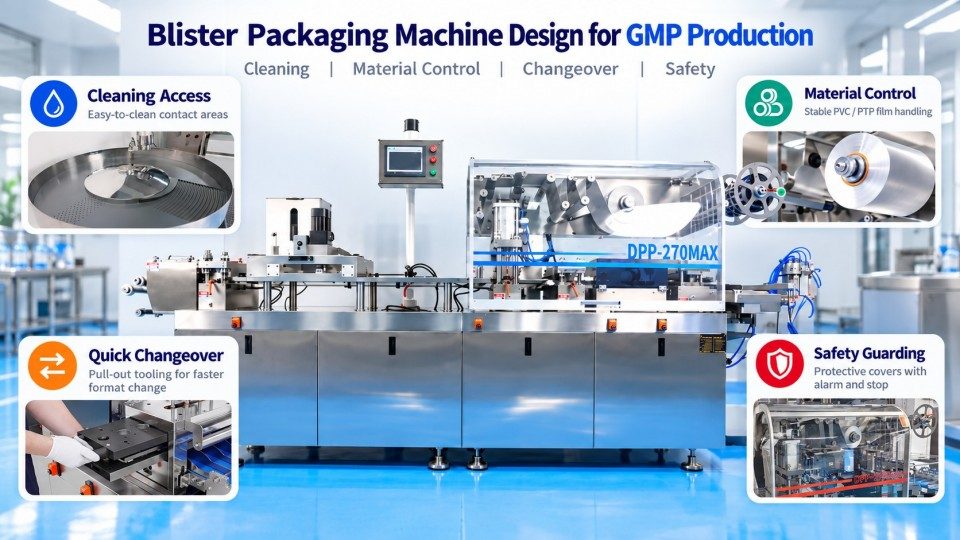
Blister packaging machine design supports GMP by reducing contamination risks, improving packaging material control, and making cleaning and changeover easier. Product-contact surfaces must be suitable for pharmaceutical use, feeding areas need to be accessible for residue removal, and material detection helps prevent continued operation with broken PVC film or aluminum foil. Pull-out forming, sealing, and punching tooling is designed to speed up tooling replacement when blister formats change.
Safety alarms, protective guards, and emergency stops address hazards around heated and moving machine parts. These features complement GMP requirements for equipment suitability, cleaning, and maintenance under FDA 21 CFR 211.63–211.67. Their effectiveness depends on appropriate equipment configuration, operating procedures, and functional checks. For pharmaceutical manufacturers, these design details influence product quality control, operator safety, and the time required for routine maintenance and batch changeovers.
GMP does not prescribe one universal blister machine layout or require every model to have the same sensors. It requires manufacturers to use equipment suitable for its intended operation, maintain it in a controlled condition, and prevent contamination and packaging mistakes. Machine design makes those tasks easier—or harder—to carry out consistently.
A feeder with difficult-to-reach corners can retain tablet dust after a batch. Poor sealing-station access complicates inspection after a foil jam; disorganized material changeovers increase mix-up risks.
In the United States, FDA 21 CFR 211.63 covers appropriate equipment design and location; 211.65 addresses surfaces that contact drug products or in-process materials; and 211.67 covers written cleaning and maintenance procedures and their records. Section 211.130 also requires controls against packaging and labeling mix-ups, including checks before packaging begins. EU GMP Chapter 3 also calls for equipment layout and design that minimize errors and allow effective cleaning and maintenance.
A stainless steel frame or protective enclosure does not make a machine independently “GMP-certified.” Manufacturers must demonstrate that equipment, cleaning methods, operating procedures, and packaging controls work for their products. Mechanical safety requires a separate assessment.
Assess equipment by linking production risks to design features and test evidence.
Small contact points near feeders, guides, joints, and removable parts can retain powder or fragments. Hygienic design combines suitable materials with access for cleaning, inspection, and maintenance.
On a tablet or capsule blister line, the feeding area is especially important because unsealed product is exposed before it enters the cavities. Residue can collect on feeder components or around the product-transfer path. Operators need enough access to remove product remains and inspect surfaces before the next operation.

Product-contact components should use suitable, cleanable materials; 316 stainless steel is one option for surfaces exposed to pharmaceutical products. This supports material durability and cleanability, but the stainless steel grade alone does not demonstrate suitability for every formulation or cleaning chemical. Manufacturers must also consider surface condition, seals, wear, and compatibility with their validated or otherwise justified cleaning procedure.
Check the feeder, contact surfaces, guide paths, joints, and fasteners. Cleaning instructions should specify part removal, reassembly, and pre-use inspection.
Electrical cabinets, drives, and lubrication points create maintenance needs that differ from those of exposed pharmaceutical product areas. A well-designed layout separates electrical and material-contact zones where appropriate, helping reduce opportunities for maintenance-related contamination.
Separation does not create a sterile enclosure. Powder, damaged seals, tools, and cleaning-agent residues still require controls. Cleaning methods depend on the product and site procedures; built-in CIP or SIP functions are not assumed.
FDA 21 CFR 211.67 calls for written cleaning and maintenance procedures, including responsibilities, methods, inspection, and records. For changeovers between different products, manufacturers should define appropriate residue acceptance limits and demonstrate cleaning effectiveness according to their contamination-control strategy. The frequency and extent of additional verification depend on risk, not on an arbitrary rule that every tooling exchange needs full requalification.
PVC forming film and PTP aluminum foil must feed without tearing or running out unnoticed. At the same time, heated sealing surfaces and moving forming and punching mechanisms need appropriate protection for operators.
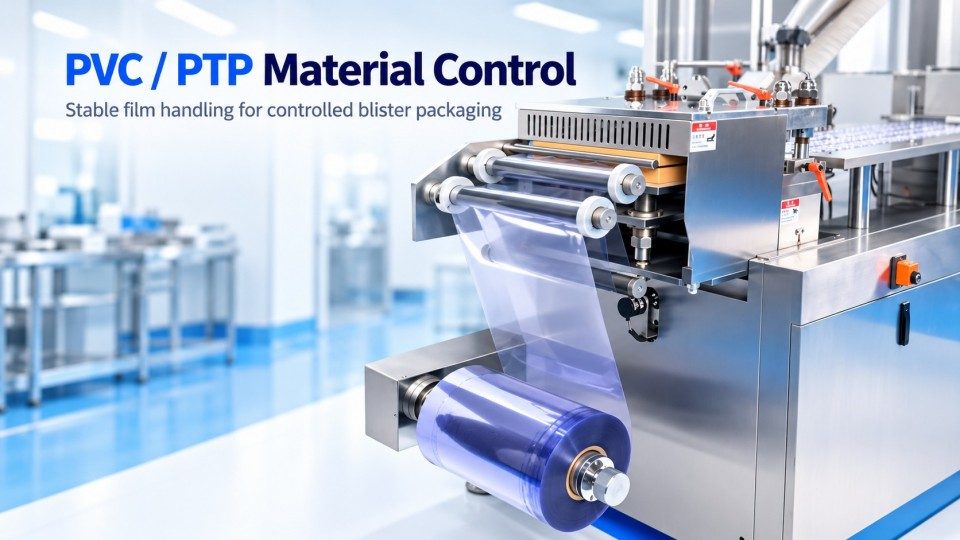
Torn PVC can disrupt cavity forming; broken lidding foil can leave pockets uncovered. Continued indexing also makes affected packs harder to identify.
A well-designed blister packaging machine can detect breaks in PVC forming film and PTP aluminum foil and stop automatically when this protection is fitted. Once the operator repairs or replaces the material, the web path and registration need to be checked. Material exposed to the fault and restart process should be handled according to the line's approved rejection and inspection procedure.
Running out of material is a separate condition. Material-exhaustion alarms notify operators when the PVC or PTP foil supply runs out. These alerts help operators respond to an empty roll, but they are not a substitute for seal-integrity testing, cavity inspection, or correct-packaging-material verification.
Guards restrict access to hazardous parts while operators are running the machine. Rich Packing’s DPP-270Max includes protective covers around its working stations and an emergency-stop function. Opening the protective cover between the heat-sealing and punching stations automatically triggers an alarm and stops the machine.
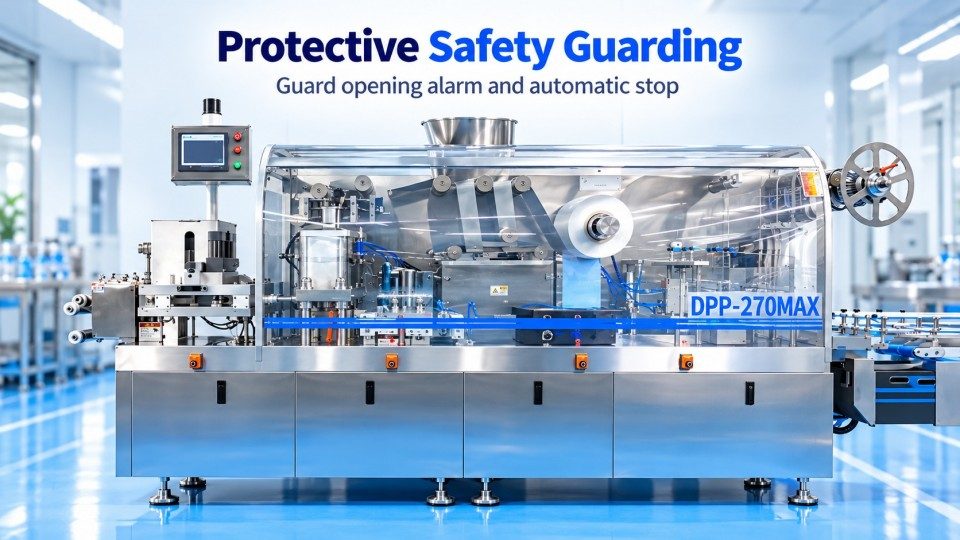
The alarm, stop response, and restart conditions should be checked against the approved safety documentation during equipment acceptance testing.
ISO 12100 provides a framework for machinery risk assessment. ISO 14120 covers the construction and selection of fixed and movable guards, while ISO 14119:2024 addresses interlocking devices used with guards. These are machinery safety standards rather than substitutes for GMP cleaning or packaging controls.
Before resuming production, operators must check the machine and any affected material.
Challenge each specified alarm through safe, documented tests. Check PVC and foil break responses, exhaustion warnings, fault messages, and restart conditions. For the protective cover between the heat-sealing and punching stations, verify both automatic alarm activation and machine stopping. Test the emergency stop under the separate approved safety procedure.
Blister machine changeovers involve packaging materials, tooling, and batch clearance. Faster mechanical work reduces one part of downtime; startup still requires approved clearance and checks.
A dedicated PVC quick-splicing platform makes film replacement more manageable. Instead of struggling to align loose film ends while working around the unwinding path, operators have a designated area for preparing the connection. This helps reduce handling difficulties during roll replacement.
Operators must follow the approved splicing procedure, confirm film specification and alignment, and exclude unsuitable spliced sections from finished packs as required.
Replacing the forming film is only one part of a material changeover. When printed PTP foil is used, operators must verify the foil specification, product identity, strength, and artwork against the approved packaging instructions before restarting. Even a correctly formed and sealed blister is unacceptable if its printed foil belongs to the wrong product or strength.
Rich Packing’s DPP-270Max uses pull-out tooling at the forming, heat-sealing, and punching stations. This design reduces the mechanical work involved in format changes: operators can withdraw an existing tool set and install a replacement without extensively dismantling surrounding assemblies.
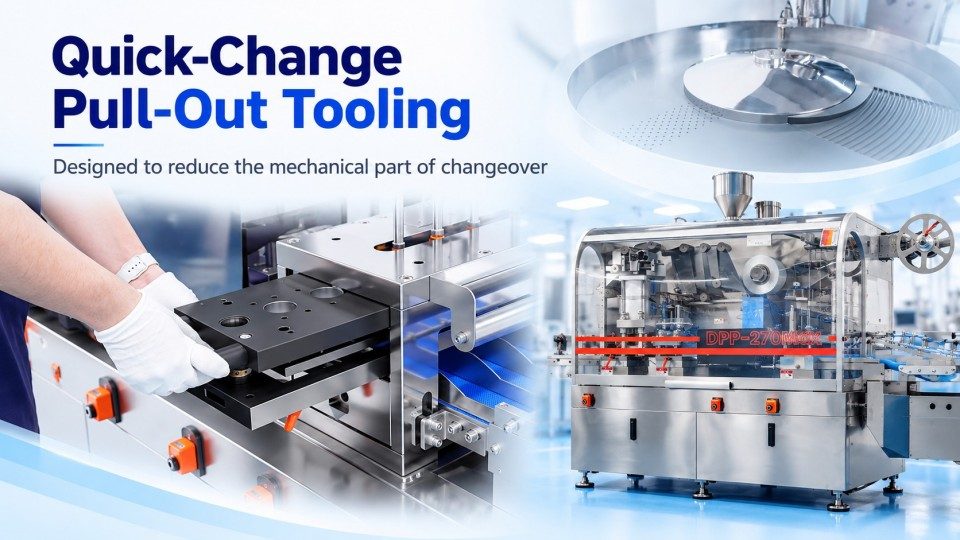
After replacement, operators must verify the tooling identity, secure installation, alignment, and settings for the next blister format. Forming depth and cavity fit, sealing conditions, and cut position all need attention because a tooling change can affect finished-pack quality.
Tooling replacement is only part of complete batch changeover, which also covers cleaning, clearance, material reconciliation, trial packs, and approval. No fixed changeover time is assumed without verified model-specific data.
Before the next batch starts, previous tablets or capsules, unused PVC and foil, printed materials, rejected web sections, and batch identifiers must be cleared as specified by the approved procedure. The new material and tooling should match the work order, and an authorized person should confirm that required checks are complete.
For example, after changing from one tablet strength to another, simply installing the correct forming die does not rule out a mix-up. Old lidding foil, leftover tablets, or an unchanged print job may still be present. FDA 21 CFR 211.130 directly addresses examination of packaging materials and inspection of packaging facilities before use. Easy-access equipment can make that inspection more practical, but it cannot replace it.
Equipment reviews should connect each user requirement to an operating risk and a documented test. A catalogue feature is not proof of performance at the installed site.
|
Production risk or requirement |
Relevant design or control |
Practical check |
|
PVC or lidding foil breaks |
Material-break detection and automatic stop |
Challenge each material-break function safely; record machine response and restart conditions |
|
PVC or foil roll runs out |
Material-exhaustion alarm |
Confirm the correct alarm appears for each exhausted material |
|
Access to moving or heated stations |
Protective guards, guard-opening alarm and automatic stop, emergency stop |
Verify alarm and machine stop when the specified cover opens; test the emergency stop against the approved safety design |
|
Powder or fragments remain after a batch |
Accessible feeder and product-contact surfaces |
Follow the approved cleaning method; inspect defined locations and record results |
|
Wrong tooling or packaging format |
Identified format parts and approved setup controls |
Verify tooling identity, positioning, fastening, material identity, and startup packs |
|
Long mechanical tooling change |
Pull-out forming, sealing, and punching tooling |
Confirm the correct tooling can be withdrawn, replaced, aligned, and secured under the approved changeover procedure |
|
Poor forming or sealing after changeover |
Controlled settings and process checks |
Inspect cavity shape, registration, seal quality, and cutting against approved acceptance criteria |
These checks can be distributed across the qualification lifecycle. At the factory acceptance test (FAT), teams can confirm specified mechanical features and simulate defined alarms before shipment. At site acceptance testing (SAT), they can assess functions that depend on installation, utilities, or the receiving environment. Installation qualification (IQ) documents installation against approved requirements, while operational qualification (OQ) challenges defined operating functions and limits. Performance qualification (PQ), where applicable, demonstrates the process under its intended production conditions. EU GMP Annex 15 describes a risk-based qualification approach; the site's approved validation plan should define the test scope according to system risks and agreed user requirements.
Packaging quality also needs its own evidence. A successful film-break alarm does not prove that every blister is properly sealed. Sealing depends on the material combination and qualified operating conditions, including temperature, pressure, and contact time where relevant to the equipment. The team should use approved tests and acceptance criteria to confirm package integrity and inspect samples after setup, material changes, and maintenance as required. No particular vision inspection or online seal-testing function should be assumed unless it is documented on the machine.
Equipment used in GMP-controlled production must be cleanable and its quality-related functions verifiable; operator safety requires separate protective measures. Compare safety functions, cleaning access, material handling, and changeover features with your user requirements, then confirm them through appropriate testing. Rich Packing’s DPP-270Max incorporates these designs: a guard-opening alarm with automatic stopping, PVC/PTP material-break detection with automatic stopping, material-exhaustion alarms, 316 stainless steel product-contact components, separated electrical and material-contact zones, a PVC quick-splicing platform, and quick-change pull-out tooling. Contact Rich Packing to discuss the configuration for your blister packaging application.
Suitable product-contact materials, accessible cleaning areas, reliable material handling, and maintainable equipment design all help. The manufacturer must also establish appropriate procedures, qualification, and documented production controls for the intended product and site.
They primarily address machinery hazards and operator protection. GMP focuses on medicine quality, contamination prevention, and controlled operations. Both are important, but machinery safety should be assessed against the applicable risk assessment and safety standards.
A broken PVC film can disrupt blister forming, while broken aluminum foil can leave blister cavities unsealed. On machines equipped with material-break detection, the system automatically stops production when a break is detected. Operators must repair the material, check its alignment, and inspect or reject affected blister packs before restarting.
No. Material grade is only one aspect of hygienic design. Contact compatibility, accessibility, surface condition, cleaning effectiveness, maintenance, and the site's quality procedures all influence suitability.
Pull-out forming, sealing, and punching tools speed up the mechanical part of blister format changes by simplifying tooling removal and replacement. Cleaning, line clearance, correct-material checks, setup verification, and required documentation remain separate steps before production can restart.
FAT can test specified functions before delivery; IQ checks installation; OQ challenges operating functions and defined limits; and PQ, when applicable, confirms process performance under intended conditions. The qualification plan should reflect product risk, machine configuration, and agreed user requirements.
1. U.S. FDA, 21 CFR Part 211, especially §§211.63, 211.65, 211.67 and 211.130
2. European Commission, EudraLex Volume 4, Part I, Chapter 3: Premises and Equipment
3. ISO, ISO 12100:2010, Risk assessment and risk reduction
4. ISO, ISO 14120:2015, Fixed and movable guards

29+ years in pharmaceutical machinery, covering capsule filling, tablet pressing, blister packaging, tablet and capsule counting, cartoning, GMP production, and overseas machine service.

بريد إلكتروني : manager@richpacking.cn
Building D, No. 226, Beishan Qiaotou Street, Haizhu District, Guangzhou City, Guangdong Province, China


 دعم شبكة IPv6