






 منزل، بيت
 منتجات

29+ years in pharmaceutical machinery, covering capsule filling, tablet pressing, blister packaging, tablet and capsule counting, cartoning, GMP production, and overseas machine service.

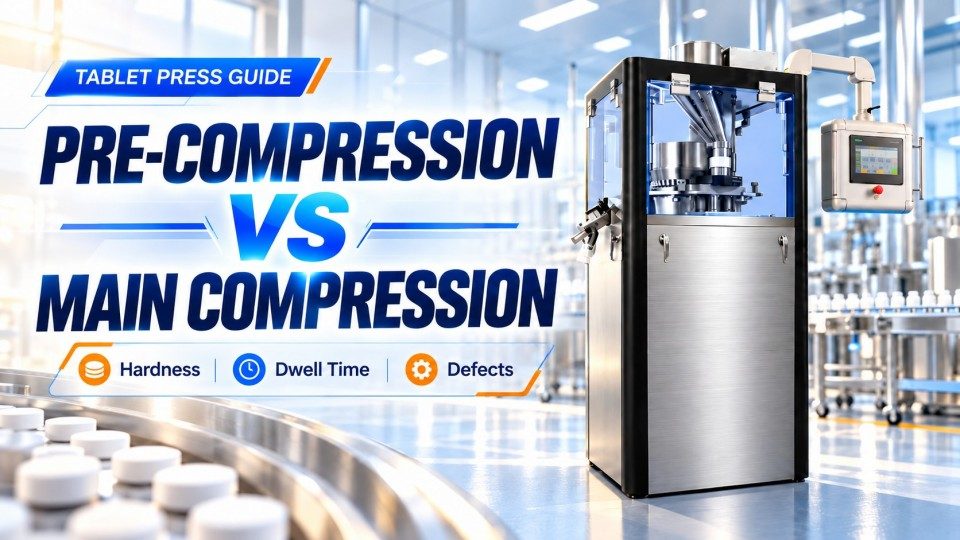
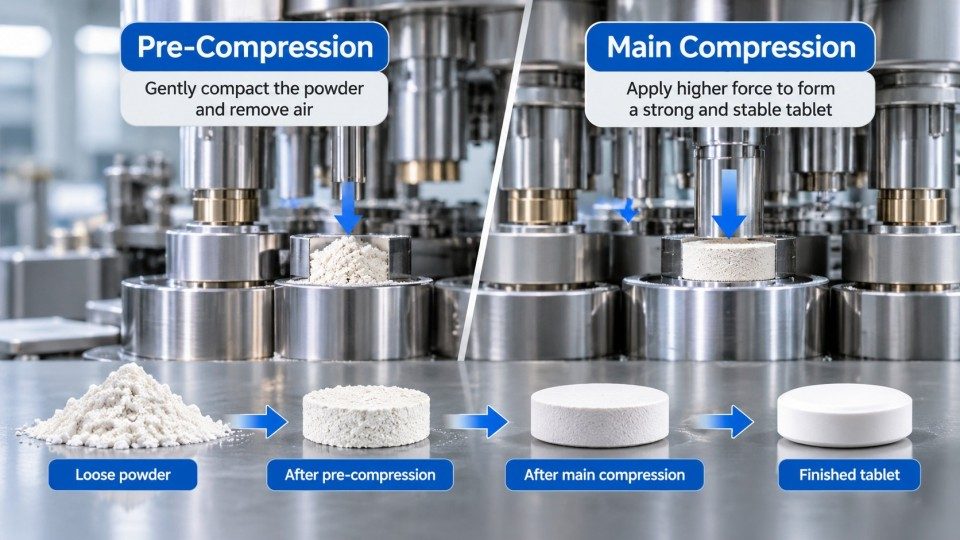
Pre-compression and main compression are two separate stages in a rotary tablet press. Pre-compression initially compacts the powder, helps particles settle and allows trapped air to escape when conditions are suitable. Main compression applies further pressure to form a tablet with the required strength. The key difference is that pre-compression prepares the powder bed, while main compression works on that already-compacted material.
Both stages affect tablet hardness, capping, lamination and production consistency. Their results also depend on the formulation, turret speed, punch design and how quickly pressure is applied and released. A higher force does not automatically produce a better tablet.
Core effects on tablet quality
Pre-compression begins powder densification; main compression completes the compaction needed for tablet strength and shape. Both stages use upper and lower punches working against compression rollers, but they act at different points in the production cycle.
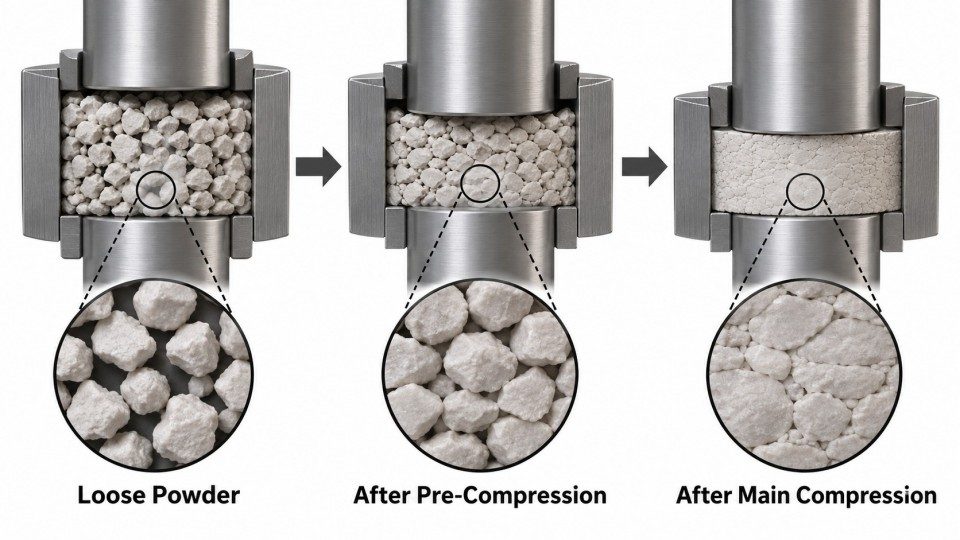
After filling, the die moves to the pre-compression station. The rollers bring the punches closer together, reducing the space occupied by powder or granules. Particles move into closer contact, larger air spaces become smaller and some air may escape. Depending on the material, particles can also begin to deform or break into smaller pieces. The rotary tablet press working principle explains the complete filling, compression and ejection sequence.
The pressure normally drops as the punches leave the first rollers. The partly formed tablet then reaches the main compression station, where further loading creates stronger contact between particles. Finally, the pressure is released and the tablet is pushed out of the die. Poorly matched or worn punches and dies can make these stages less consistent.
|
Comparison |
Pre-compression |
Main compression |
|
Position |
First compression station |
Second compression station |
|
Main purpose |
Settle and partly compact the powder |
Build final density and tablet strength |
|
What happens to particles |
Rearrangement, initial deformation and possible air release |
Further deformation and stronger particle bonding |
|
Main settings |
Pre-compression force and loading speed |
Main compression force, loading speed and dwell time |
|
Effect on quality |
Changes how the powder responds to the next stage |
Strongly influences final hardness and tablet integrity |
Compression force and compression pressure are different. Force is the load applied by the punches, usually shown in kN. Pressure describes that load over the punch contact area, usually in MPa. The same force can produce different pressures on tablets of different sizes. That is why settings should not be copied between tooling sizes without checking the actual process.
Main compression usually makes the largest contribution to final tablet strength, but pre-compression can change how effectively that force works. A tablet that is poorly conditioned during the first stage may behave differently from one with more uniform initial compaction.
Pre-compression changes how closely particles are packed before they reach the main rollers. If it helps the powder rearrange and release air, main compression may create a stronger tablet without an increase in its peak force. If pre-compression is unsuitable for the material, it may provide little benefit or introduce unwanted stresses.
Published formulation research confirms that the relationship between the two stages depends on the powder being compressed. Some formulations respond well to a lower initial force, while others respond differently. There is no universal percentage of main compression force that works as the best pre-compression setting for every tablet.
Increasing main compression is not an unlimited solution either. Tablets may become denser and stronger as force rises, but strength can level off, and excessive force may contribute to defects or interfere with other product requirements. A useful setting must meet more than a hardness target.
Tablet hardness usually means breaking force: the load needed to fracture a finished tablet, measured in N. Tensile strength, measured in MPa, takes tablet geometry into account when an appropriate calculation is used. Friability measures how much material a tablet loses through repeated movement and abrasion. These are related properties, but they are not interchangeable.
A tablet can pass a breaking-force test and still chip during handling. Another can be mechanically strong but fail the required disintegration or dissolution specification. Checking tablet hardness problems alongside tablet friability gives a more complete picture than looking at compression force alone.
Tablet weight, thickness and porosity can help explain a strength change. If a tablet becomes harder because its particles pack more closely, that is not necessarily the same as improving the bonds between those particles.
Turret speed controls how quickly punches pass through each compression station, while punch and roller design affect how the force builds and falls. For this reason, the same rpm does not guarantee the same compression result on different machines or with different formulations.
Dwell time is commonly described as the short period when a punch is under high compression near the roller. Geometric dwell time is estimated from machine geometry and speed. Force-based dwell time is calculated from the measured force curve using a stated force level. The two measurements are related but not identical.
Research comparing these definitions found that the calculated machine dwell could stay unchanged while measured force-based dwell differed between powder mixtures and compression conditions. For operators, the useful lesson is simple: an rpm setting tells only part of the story.
Higher turret speed generally shortens the time available for die filling and compression. With some powders this can reduce tablet strength or increase weight variation. Other formulations tolerate higher speed well, so a slower machine is not automatically the best machine. The actual quality results must determine the usable speed range.
The shape of the punch head and the size and position of the compression rollers influence how quickly the punches close, how long they remain near peak force and how pressure is released. A change in tooling or press design can therefore change tablet quality even when the displayed peak force looks similar.
A useful way to view the process is pre-compression → pressure release → main compression → final release and ejection. Each step can affect the next. When comparing tablet press machines, examine compression control, tooling and sustained production quality rather than maximum speed alone. Also check feeder performance: a short filling window can create tablet-weight variation before compression starts.
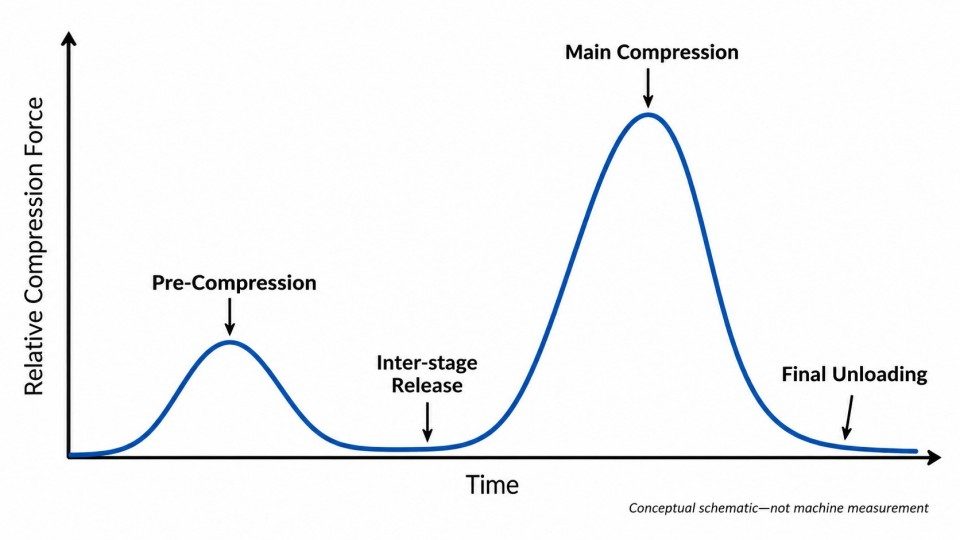
Conceptual tablet press force-time curve showing pre-compression, pressure release and main compression
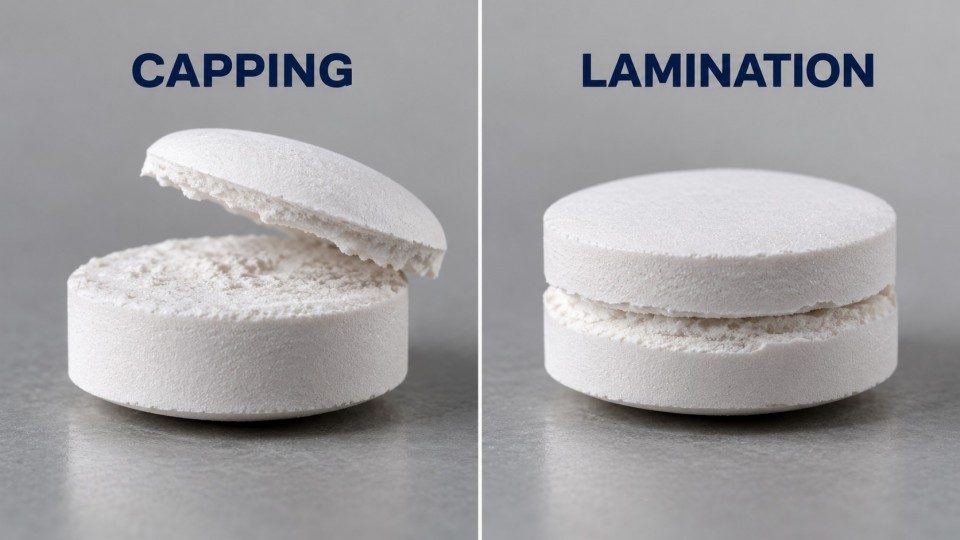
Capping and lamination occur when a compact cannot withstand stresses created during compression, pressure release or ejection. Trapped air is a common cause, but it is not the only one. Increasing compression force without identifying the cause can make the problem worse.
If the powder is compressed too quickly, air may become trapped as the spaces between particles close. When the punches release pressure, the air expands while the particles recover part of their original shape. If the tablet's internal bonds are too weak, its top can separate or its body can split into layers.
Pre-compression can help by giving the powder an earlier opportunity to settle and release air. Research also shows that trapped air can contribute to the expansion measured inside the die. That means an unusually large recovery after compression does not always come from the powder's own elasticity.
Pre-compression and main compression work as separate events, not simply one long squeeze. In a published capping study, allowing the first load to fall before main compression prevented capping in the tested formulation, while keeping the load continuous did not. This does not mean every press needs the same interval; it shows why the pressure-release stage can matter.
Lamination can also begin during ejection, when friction between the tablet and die wall creates stress. Other cracks develop as the tablet expands after compression. Research has shown that these different mechanisms do not all respond to pre-compression in the same way. If tablet defects persist, examine when and where the tablet breaks instead of repeatedly increasing the force.
Different powders need different compression conditions because their particles bend, break and bond in different ways. The machine then adds another variable: how it applies and releases the force.
Microcrystalline cellulose (MCC), a common tablet excipient, often forms bonds by changing shape under pressure. Some calcium phosphate materials behave more like brittle particles and break into smaller pieces, creating new contact surfaces. Powders that recover strongly after compression or trap air easily can be more sensitive to speed and pre-compression.
Particle size, moisture, lubricant level and granulation also affect the result. A powder may pack densely but still form weak tablets if its particles do not bond well. Researchers distinguish compressibility (how easily powder becomes denser), tabletability (how much strength develops at a given pressure) and compactibility (how much strength develops at a given density). These terms help explain why density and hardness do not always rise together.
The practical point is that settings proven with one formulation may not work with another, even when the tablet dimensions are the same. A fixed pre/main compression ratio ignores these material differences.
Check the compression rollers, punch-head shape, supported tooling, force adjustment and monitoring functions. These features influence how force reaches the powder. Tool wear, poor die condition or unstable filling can also change the result over time. The tablet press tooling must match both the material and the intended tablet shape.
When making a tablet press machine selection, compare the machine's practical control range and consistent output, not only its advertised maximum force or production rate. Those maximum specifications cannot predict tablet quality for an untested formulation.
The best pre-compression and main compression settings are the ones that repeatedly produce tablets meeting the required quality limits at the intended production speed. There is no single force ratio or dwell-time target suitable for every formulation.
Keep the formulation, tooling and tablet-weight target consistent when comparing approved settings. Observe the following groups rather than changing several unrelated variables at once:
A stronger tablet is not necessarily a better tablet if it fails friability, disintegration or other specifications. Routine pharmaceutical equipment maintenance also matters, because worn tools and inconsistent feeding can make a previously stable setting unreliable.
Start with what the defective tablet shows. If tablets are weak and unusually porous, check whether the powder is being compacted adequately. If capping appears as speed rises, investigate air release, loading rate and powder behavior. If layers split during ejection, inspect die friction and tooling rather than assuming that more pre-compression will solve the problem.
For a new machine, define the product range, tooling, required speed, compression controls and quality acceptance criteria in a user requirement specification. Rich Packing can discuss a suitable tablet press configuration against these requirements, while the final formulation-specific settings must be established and confirmed on the intended equipment.
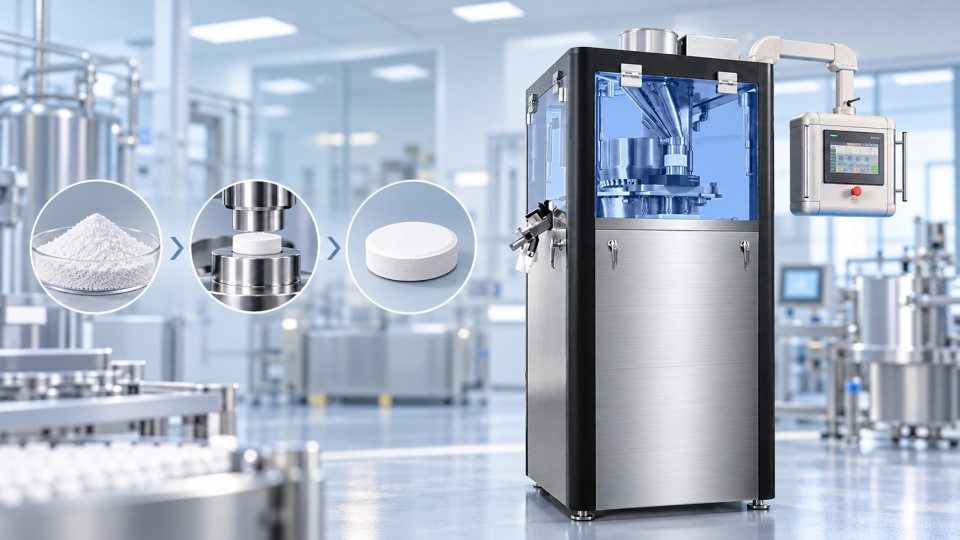
The takeaway: pre-compression prepares the powder, main compression builds the tablet, and both must be evaluated through finished-tablet quality. Force, speed and dwell time are machine settings; consistent strength, low defect rates and reliable output are the results that matter.
Pre-compression partly compacts and conditions the powder. Main compression further consolidates it to form the tablet's final structure and strength.
No. A separate pre-compression station is available only on machines designed with that feature.
No. It is often lower in routine production, but the useful relationship depends on the formulation and machine.
There is no single suitable force for every tablet. Material properties, tooling, speed and quality targets determine the setting.
Yes. Proper pre-compression can improve how particles pack and bond, but the effect must be confirmed with the actual material.
No. Strength can stop increasing, and excessive force can contribute to defects or affect other quality requirements.
No. Higher speed changes filling and compression time, but the result depends on the formulation, tooling and force profile.
It can help when trapped air or loading history is involved. It cannot correct every defect caused by unloading or ejection.
Hardness commonly refers to breaking force in N. Tensile strength expresses strength in MPa using a suitable calculation for tablet shape.
Compare the two compression stages together with speed, tooling, material behavior and finished-tablet tests under approved production procedures.
Ruegger CE, Celik M. Pharmaceutical Development and Technology. 2000;5(4):495–505.
[2] Dwell Time on Tableting: Dwell Time According to Force Versus Geometric Dwell Time
Mohylyuk V. Pharmaceutical Development and Technology. 2024;29(7):719–726.
Vreeman GW, Sun CC. International Journal of Pharmaceutics. 2022;615:121514.

29+ years in pharmaceutical machinery, covering capsule filling, tablet pressing, blister packaging, tablet and capsule counting, cartoning, GMP production, and overseas machine service.

بريد إلكتروني : manager@richpacking.cn
Building D, No. 226, Beishan Qiaotou Street, Haizhu District, Guangzhou City, Guangdong Province, China


 دعم شبكة IPv6