






 منزل، بيت
 منتجات
29+ years in pharmaceutical machinery, covering capsule filling, tablet pressing, blister packaging, tablet and capsule counting, cartoning, GMP production, and overseas machine service.

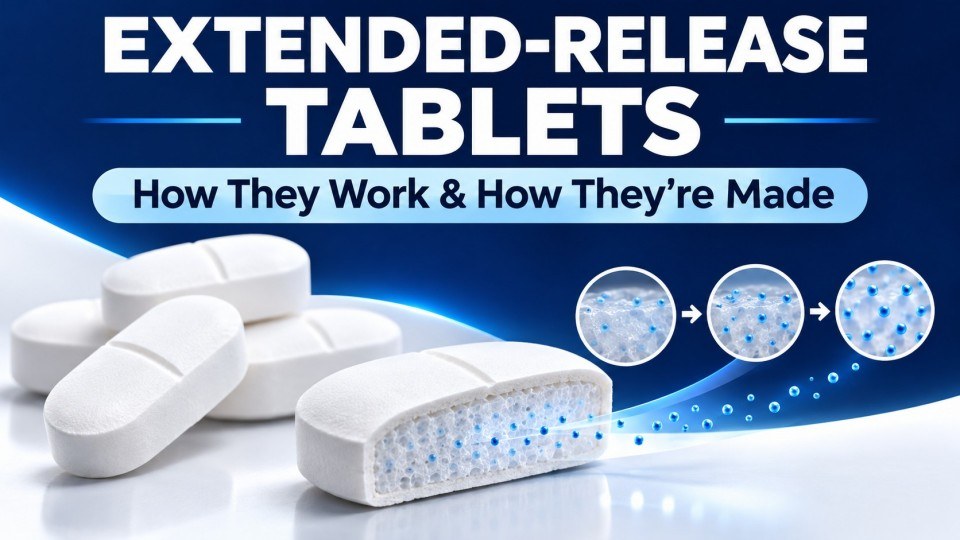
Have you ever wondered how one tablet can keep releasing medicine for hours?
Extended-release tablets are designed to release a drug over a longer period than immediate-release tablets. Depending on the medicine, this can mean fewer doses throughout the day.
But a tablet does not achieve extended release simply because it is compressed more tightly or covered with a coating. Its release profile comes from a carefully designed formulation and manufacturing process.
In this article, we’ll explain how extended-release tablets work, their benefits and limitations, and what manufacturers need to consider when producing them.
Key Takeaways
An extended-release tablet, often abbreviated as an ER tablet, is designed to make a drug available over an extended period after it is taken.
The goal is to control how the drug is released rather than allow the entire dose to become available as quickly as it would from a conventional immediate-release product.
You may also see abbreviations such as XR, SR or CR on medicine packaging. These labels generally indicate a modified-release product, but the exact instructions depend on the specific medicine.
The main difference is how long the tablet is designed to release its active ingredient.
|
Feature |
Immediate-Release Tablet |
Extended-Release Tablet |
|
Drug release |
Releases the drug without a designed extended-release mechanism |
Releases the drug over a longer period |
|
Dosing frequency |
May require more frequent doses |
May allow fewer doses |
|
Tablet design |
Formulated for prompt release |
Uses a mechanism to control release over time |
|
Examples of labels |
Often labeled as a standard tablet |
May include ER, XR, SR or CR |
For example, a medicine available in both forms might be taken more frequently as an immediate-release tablet and less frequently as an extended-release tablet. However, the schedule depends on the product and the patient’s treatment plan.
A longer release period does not automatically mean the medicine works better. It means the medicine has been designed to release differently.
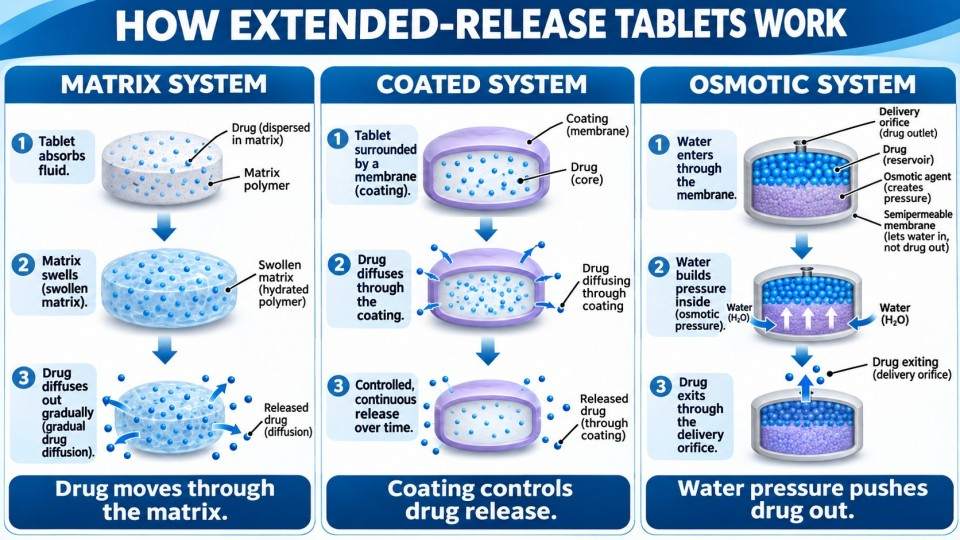
Extended-release tablets work by controlling how fluid enters the tablet or how the drug leaves it. The exact mechanism depends on the formulation.
Common approaches include:
Think of the release mechanism as a control system built into the tablet. The drug, excipients and tablet structure work together to produce the intended release profile.
Not every ER tablet uses all three methods. The right approach depends on the drug and the intended treatment.
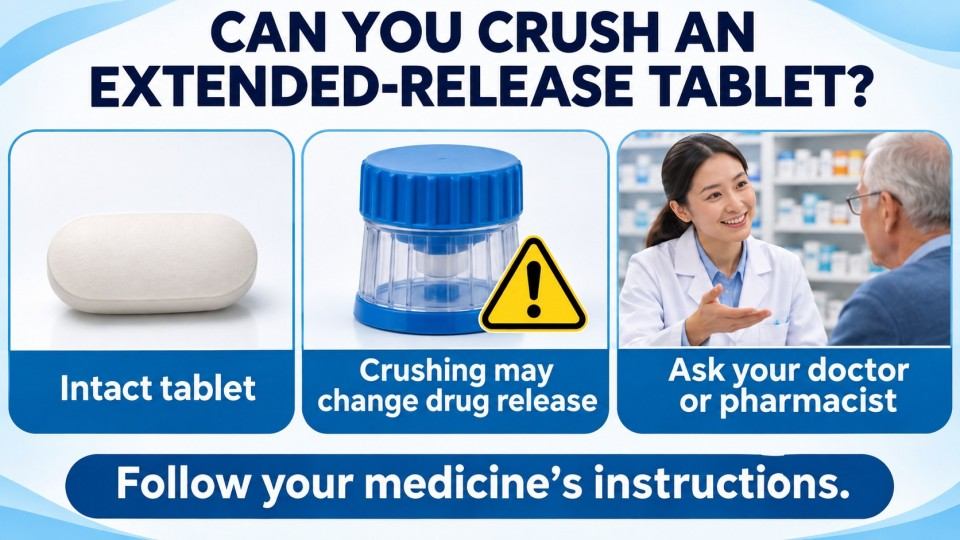
Do not crush, chew or split an extended-release tablet unless the product instructions and your healthcare professional say it is safe.
Crushing can damage the structure that controls drug release. Depending on the product, this may cause the medicine to be released too quickly and increase the risk of side effects or reduce the intended duration of action.
Some ER tablets are designed to be split, but that does not mean they can also be crushed or chewed. A score line alone is not enough to decide whether splitting is appropriate.
If swallowing a tablet is difficult, ask a pharmacist or doctor about suitable alternatives.
Extended release controls how long a drug is released. Delayed release changes when or where release begins.
For example:
An enteric coating is a common way to achieve delayed release. It helps protect a tablet from the acidic environment of the stomach so that release can occur later in the digestive tract.
Some products can combine delayed-release and extended-release features, but the terms describe different functions.
ER, SR and CR commonly stand for extended release, sustained release and controlled release.
These terms are often used for products designed to release medicine over a longer period. Their use can vary between manufacturers and regulatory contexts, so the abbreviation alone does not tell you exactly how a specific tablet releases its drug.
If you want to know how to take a particular medicine, follow its product instructions and ask your healthcare professional.
The main benefit of an extended-release tablet is that it can deliver medicine over a longer period, which may reduce how often a patient needs to take it.
Some ER medicines are designed to be taken once or twice a day instead of more frequently. A simpler schedule may be easier for some patients to follow.
However, the actual dosing schedule depends on the medicine and the person taking it.
By releasing medicine over a longer period, some ER formulations can help reduce fluctuations in drug concentration compared with an immediate-release version.
This does not mean that every ER product produces a perfectly constant drug level. The release pattern depends on the drug, formulation and how the body absorbs it.
For medicines taken over a long period, fewer daily doses may make treatment more convenient. An ER formulation may also be useful when a medicine is intended to provide an effect throughout a longer part of the day.
Not necessarily. Extended-release tablets can be useful, but the best formulation depends on the medicine, treatment goal and patient.
An immediate-release tablet may be preferred when a faster onset or more flexible dosing is needed. An extended-release tablet may be preferred when maintaining drug delivery over a longer period is the priority.
A healthcare professional can help determine which version is appropriate.
Extended-release tablets offer convenience, but their design also creates limitations.
For patients, the most useful rule is simple: follow the instructions for the specific product. ER tablets containing the same drug can have different designs and handling instructions.
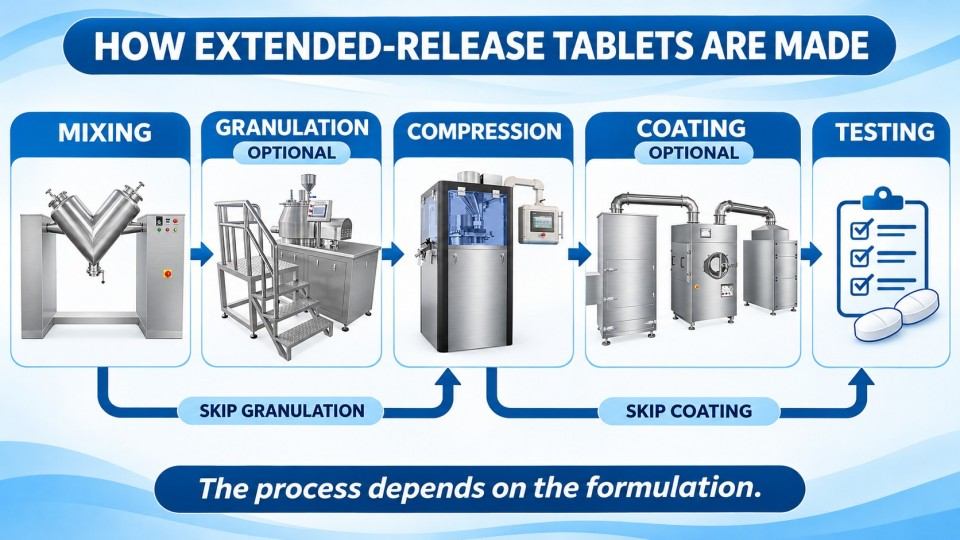
Extended-release tablet manufacturing starts with the intended release profile. The formulation and process are then developed to produce that profile consistently.
There is no single process for every ER tablet. A matrix tablet, for example, may follow a different route from a tablet containing coated particles.
A typical process may include the following steps.
The development team selects the active pharmaceutical ingredient, or API, and the excipients needed to produce the desired tablet.
For an ER matrix tablet, the formulation may include a polymer that helps control how water enters the tablet and how the drug is released.
The team evaluates questions such as:
The API and excipients are prepared and mixed to create a blend.
Blend uniformity matters because the active ingredient and release-controlling materials need to be distributed appropriately throughout the batch. If the blend is inconsistent, tablets made from different parts of the batch may perform differently.
Mixing time, material properties and equipment design all need to be considered for the specific formulation.
Some formulations require granulation before compression. Granulation brings powder particles together into larger aggregates, which can help improve properties such as flow or compressibility.
Depending on the formulation, manufacturers may use:
The choice depends on the materials and the process developed for the product. Granulation is not required for every ER tablet.
The prepared blend or granules are fed into a tablet press, which compresses the material into tablets.
The aim is to produce tablets that meet the product’s specifications for attributes such as weight, thickness and mechanical strength.
For an ER tablet, compression must also be considered alongside the release mechanism. Changes in tablet structure can affect how fluid moves through some formulations and, in turn, how the drug is released.
Some extended-release tablets use a functional coating to help control drug release. Others may receive a coating for a different reason, such as appearance or ease of handling.
A matrix tablet can be designed to achieve extended release without a functional outer coating. Therefore, not every coated tablet is an ER tablet, and not every ER tablet needs a coating.
After manufacturing, the tablets are evaluated against product-specific requirements.
Tests may include:
Dissolution testing is especially important for ER products because it helps assess whether the tablet releases the drug according to its intended profile.
A tablet press affects the physical properties and consistency of the tablets it produces. For some ER formulations, those properties can also influence drug release.
However, the press is only one part of the process. The formulation, material properties, mixing and any coating steps also contribute to the finished product.
Before compression, the material must flow into the dies of the press. If feeding is inconsistent, the amount of material in each die can vary, leading to tablet weight variation.
For ER production, manufacturers need to assess how the blend or granules behave at the intended production speed and how consistently the press can feed them.
Compression force, press speed and tooling can influence tablet properties such as thickness and mechanical strength.
For some matrix formulations, changes in processing can also affect how the tablet interacts with fluid and how the drug dissolves. The relationship is formulation-specific: a setting that works for one product cannot be assumed to work for another.
During production, manufacturers monitor selected tablet and process measurements to check whether the process remains within its established limits.
Depending on the machine and process, useful information may include:
These measurements support process monitoring, but they do not replace product-specific dissolution testing.
Making an ER tablet is not just about producing a tablet that looks consistent. The manufacturer also needs the tablet to deliver the intended release profile.
Differences in particle size, powder flow or the distribution of a release-controlling polymer can affect processing and tablet performance.
What manufacturers can do: Define relevant material specifications and evaluate blend uniformity during development and production.
A formulation that works well on a laboratory press may behave differently on a larger or faster machine. Feeding, dwell time and compression conditions may change.
What manufacturers can do: Evaluate the formulation on the intended equipment and monitor the tablet properties that matter for the product.
A tablet can meet physical requirements and still fail to meet its intended dissolution profile. This is why appearance or hardness alone cannot confirm ER performance.
What manufacturers can do: Use a product-specific dissolution method and investigate the formulation and process together when results change.
Moving from development to commercial production may involve a larger batch, different equipment or a new manufacturing site.
What manufacturers can do: Compare the old and new processes, assess relevant equipment differences, and use product-specific data to evaluate the effect on tablet quality and drug release.
The appropriate assessment depends on the product and the applicable regulatory requirements.
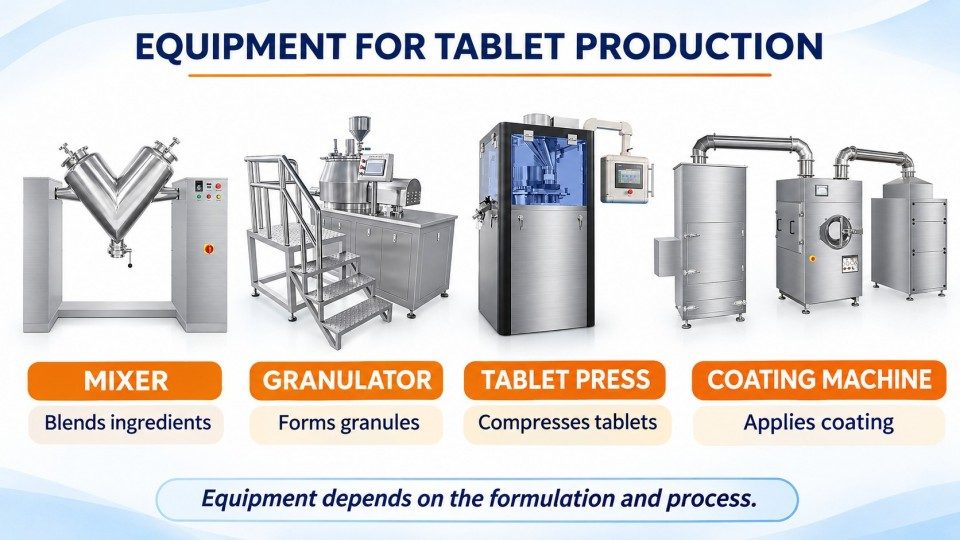
The equipment used to make extended-release tablets depends on the formulation and production process. A typical line may include mixing equipment, a tablet press, and, when the product design requires it, a coating machine.
For a matrix tablet, the tablet press forms the powder or granules into tablets. Consistent feeding and compression help manufacturers control physical properties such as tablet weight and strength. The effect on drug release still needs to be evaluated for the specific formulation.
|
Equipment |
Role in Production |
When It May Be Used |
|
Mixer |
Blends the API and excipients |
When preparing the formulation before compression or granulation |
|
Granulator |
Forms granules to support suitable material properties |
When the formulation requires wet or dry granulation |
|
Tablet press |
Compresses the prepared material into tablets |
During tablet formation |
|
Coating machine |
Applies a coating to tablets or other units |
When a functional or other coating is required |
When selecting equipment, manufacturers should consider:
Rich Packing supplies mixers, granulators, tablet presses, and coating machines for pharmaceutical production. Equipment selection depends on the formulation and process. For pharmaceutical projects, the team can also discuss GMP-oriented design, cleaning requirements, factory acceptance testing (FAT), and documentation needs.
Extended-release tablets are designed to make medicine available over a longer period. Depending on the product, this can reduce dosing frequency and make treatment more convenient.
The release mechanism also shapes how the tablet is manufactured. From formulation and mixing to compression and dissolution testing, each stage needs to support the product’s intended performance.
For manufacturers, the most effective starting point is to define the formulation and production requirements first, then select and evaluate the equipment around them.
It depends on the product. Extended release describes how the drug is made available over a longer period; it does not tell you exactly when a medicine will start working.
Some products are designed with an initial-release component, while others have a different release pattern. Ask a healthcare professional about the specific medicine.
Not necessarily. Extended release refers to the rate or duration of drug release, not a requirement that the tablet remain in the stomach.
Some specialized products are designed to remain in the stomach longer, but this is not a feature of all ER tablets.
Only if the specific product instructions say it can be split and your healthcare professional recommends it.
Most sustained-, controlled- or timed-release tablets are not intended to be split. Even when a product can be divided, it may still need to be swallowed without crushing or chewing.
No. Extended release is designed to release the drug over a longer period. Delayed release is designed to postpone the start of release. A product may combine both features.
No. Some ER tablets use a coating to control release, while others use a matrix or another release system. The formulation determines whether a coating step is needed.
This article is for general educational purposes only and does not replace professional medical advice. If you have questions about your medication, including whether a tablet can be crushed or split, consult your doctor or pharmacist.
1. U.S. Food and Drug Administration (FDA): Tablet Splitting
2. FDA: Bioavailability Studies Submitted in NDAs or INDs — General Considerations
3. FDA: SUPAC-MR — Modified Release Solid Oral Dosage Forms: Scale-Up and Postapproval Changes

29+ years in pharmaceutical machinery, covering capsule filling, tablet pressing, blister packaging, tablet and capsule counting, cartoning, GMP production, and overseas machine service.

بريد إلكتروني : manager@richpacking.cn
Building D, No. 226, Beishan Qiaotou Street, Haizhu District, Guangzhou City, Guangdong Province, China


 دعم شبكة IPv6